Catégorie: "Painting"
Pages: 1 2 3 4 5 ...6 ...7 8 9 >>
07.03.20
Mes collages
Warning: "continue" targeting switch is equivalent to "break". Did you mean to use "continue 2"? in /home/bstep754/public_html/blog/inc/plugins/model/_plugins_admin.class.php on line 1467
Je me sens comme un instrumentiste jouant diverses partitions allant de la Renaissance à aujourd’hui. Mais en fait, j’en suis également le compositeur. Les morceaux de papier que j’utilise sont des notes, des suites de notes, des lignes mélodiques. Il en résulte une grande variété stylistique que j’assume au nom de la variété. Rien ne m’ennuie tant que de voir un artiste répétant inlassablement les mêmes formules, le même concept de base. Il n’y a qu’à regarder la flore et la faune pour constater que la diversité y fait loi. Mais alors, comment reconnaître un collage fait par moi ? Je crois que ce qui relie tous mes collages entre eux, c’est leur hardiesse et leur liberté d’assemblage. Bien entendu, cela varie d’une œuvre à l’autre, je ne suis pas un robot ou un algorithme et mon talent a ses limites. Mais je me dis que je ne tourne pas en rond, que je découvre sans cesse de nouvelles associations formelles. Ce qui a enrichi ma gamme, ce sont les magazines anciens. D’une part à cause de l’inévitable nostalgie d’un monde perdu, mais également pour leur force évocatrice du fait de leur décalage temporel. Une photo d’actualités d’alors ressemble davantage à un dessin ancien qu’à une photo actuelle à cause du manque de définition qui engendre un flou inconnu de nos jours. Pour moi, cela évoque mes propres souvenirs qui, à quelques exceptions près, perdent leurs contours dans une sorte de brume. J’ai compris que les strates du temps pouvaient constituer un élément constitutif du collage pour parler d’aujourd’hui. Pour le regardeur, cela implique une attention qui fait largement défaut du fait du balayage rapide d’une image à l’autre. Mais l’image fixe n’est-elle pas, par nature, destinée à être contemplée au lieu d’être traitée comme le fragment d’une séquence filmée ? Il incombe donc à mes regardeurs de prendre un peu de temps pour s’immerger dans un de mes collages et de laisser le temps à leur sensibilité de faire naître des réflexions à la manière dont résonne une corde sympathique.

I feel like an instrumentalist playing various scores ranging from the Renaissance to today. But in fact, I’m also the composer. The pieces of paper that I use are notes, suites of notes, melody lines. The result is a great stylistic variety which I assume in the name of the variety. Nothing bores me as much as seeing an artist tirelessly repeating the same formulas, the same basic concept. You only have to look at the flora and fauna to see that diversity rules there. But then, how can I recognize a collage made by me? I think that what connects all of my collages to each other is their boldness and their freedom of assembly. Of course, it varies from one work to another, I am not a robot or an algorithm and my talent has its limits. But I tell myself that I'm not going around in circles, that I am constantly discovering new formal associations. What enriched my range are old magazines. On the one hand because of the inevitable nostalgia for a lost world, but also for their evocative force due to their time difference. A news photo from then looks more like an old drawing than a current photo because of the lack of definition that creates a blur unknown today. For me, it evokes my own memories which, with a few exceptions, lose their contours in a kind of mist. I understood that the strata of time could constitute a constitutive element of the collage to speak of today. For the viewer, this requires attention that is largely lacking due to the rapid scanning of one image to another. But isn't the still image, by nature, intended to be contemplated instead of being treated as the fragment of a filmed sequence? It is therefore up to my viewers to take a little time to immerse themselves in one of my collages and to allow time for their sensitivity to give rise to reflections in the way a sympathetic cord resonates.
Form is loading...
05.01.20
Liberté
En relisant, de manière un peu désordonnée, un livre sur la schizophrénie et l’art, voici ma réflexion. Il est clair que certains artistes comme Wölffli par ex. (abondamment cité dans l’ouvrage) sont absolument remarquables et que leur œuvre d’une grande richesse ouvre des horizons nouveaux aux artistes. Il est également vrai qu’il s’agit là d’univers clos, obsessionnels, qui sont de toute évidence reliés à des problématiques intrapsychiques, mais aussi mus par une force créatrice irrésistible. On peut également tirer des parallèles avec des artistes dont les obsessions peuvent se rapprocher de l’art brut. Mais ce qui les distingue à mes yeux, c’est la notion de liberté. Si je compare l’univers de Klee à celui de Wölffli ou certains expressionnistes à celui de Louis Soutter par ex. ou d’Eloïse, ce qui me frappe d’emblée, c’est la liberté de Klee, et notamment le fait qu’il joue avec les formes. Il n’est pas leur esclave ou leur serviteur. Et si je prends maintenant ma modeste expérience personnelle, je me rappelle certains moments de tension extrême dans la création, le sentiment de ne plus pouvoir en « sortir », de m’y perdre. Mais ce sentiment n’était pas dû au sujet du tableau, il naissait de mon impuissance à achever la composition. Je me battais contre ma propre incompétence et je vivais cet échec de manière dramatique. Mais bon, j’étais jeune et je voyais bien que je n’arrivais pas à faire les peintures auxquelles j’aspirais.
Le collage, que je pratique depuis plus de 50 ans, est la parfaite illustration de cette liberté et de la nécessité d’arriver à maîtriser la composition. Même si je constate qu’il existe des thèmes récurrents dans mes milliers de collages, ils ne se ressemblent pas, car je ne suis pas obsédé par tel ou tel motif. Au contraire, je me laisse inspirer par ce que je peux découvrir dans un magazine, par le défi que je dois relever pour trouver une cohérence et un sens dans l’assemblage de morceaux disparates. A chaque collage, j’oscille entre différentes solutions, je procède à des changements plus ou moins radicaux, je frise le chaos. Mais j’en ressors aussi à chaque fois. Pour moi, c’est bien la lutte de la forme contre la non-forme. Vie et mort. Mais je n’en suis pas prisonnier. Si je veux faire un collage avec des fleurs et de petits oiseaux, rien ne m’en empêche. Si je veux faire un collage genre art brut, aucun problème. Ce sont des genres dont je peux me servir. J’en ai la maîtrise. En photo aussi, grâce à la double exposition, je peux faire des collages numériques instantanés en glanant de ci et de là ce qui m’inspire, me heurte ou m’amuse. J’ai donc beaucoup de joie à faire ce que je fais. Le seul regret que j’ai parfois, c’est de ne pas avoir un talent plus grand, d’avoir dû travailler longtemps pour arriver à un résultat relativement modeste comparé aux Grands. Mais dès que je prends des photos ou que je fais un collage, j’oublie tout cela et crée dans la jubilation.

Vous devez être connecté pour voir les commentaires. Se connecter maintenant!
Formulaire en cours de chargement...
21.10.19
Flottement


Evidemment, je me retrouve dans cette image, puisque j’en suis l’auteur. Après un séjour au bord de la mer, en plein été, me voici au cœur de l’automne pour une période de repos centrée sur ma place de travail. Si dans cette image, mon corps se confond avec la pierre, c’est parce qu’il vieillit et se délite au fur et à mesure que le temps s’écoule. Cependant, ma tête reste préservée, mes jambes aussi, et malgré quelques trébuchements à Berlin et à Nice, je suis en forme. C’est peut-être le flottement du corps qui est plus intéressant que l’énumération des bobos. Il reste à la fois ancré dans la pierre et la neige et flotte malgré cela au-dessus de l’eau. Comment est-ce possible ? Seule l’image le peut. A y voir de plus près, je m’aperçois aussi que ce torse de pierre est en train de fondre, de se défaire, de se liquéfier. Je pense alors à la Montagne Magique de Thomas Mann que je viens de relire où Hans Castorp se détache du monde « d’en bas » et où le temps prend une toute autre dimension. Le torse me fait penser aux poumons tuberculeux, le corps couché aux longues séances allongées au sanatorium. Bref, il ne s’agit pas de moi ici, mais d’une image aux multiples réminiscences. Ainsi , par ex. le flottement dans l’eau qui me ravit à chaque fois que je me baigne dans la mer. Je me couche sur le dos et contemple le ciel bleu en faisant le moins de mouvements possibles, me laissant flotter au gré des vaguelettes, oubliant la plage et les autres baigneurs. Ou bien, je me laisse écraser par une grosse vague qui me pousse vers le fond. Je ne résiste pas, je me laisse faire : le reflux me fera remonter à la surface. Un détail de cette image me fait sourire : la montre, objet dérisoire ici dans la suspension du temps, mais qui rappelle son inexorabilité.
You must be logged in to see the comments. Log in now!
Form is loading...
05.07.19
Jardin
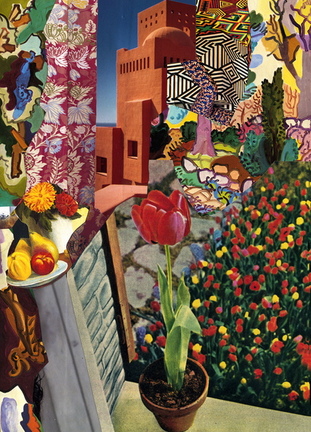
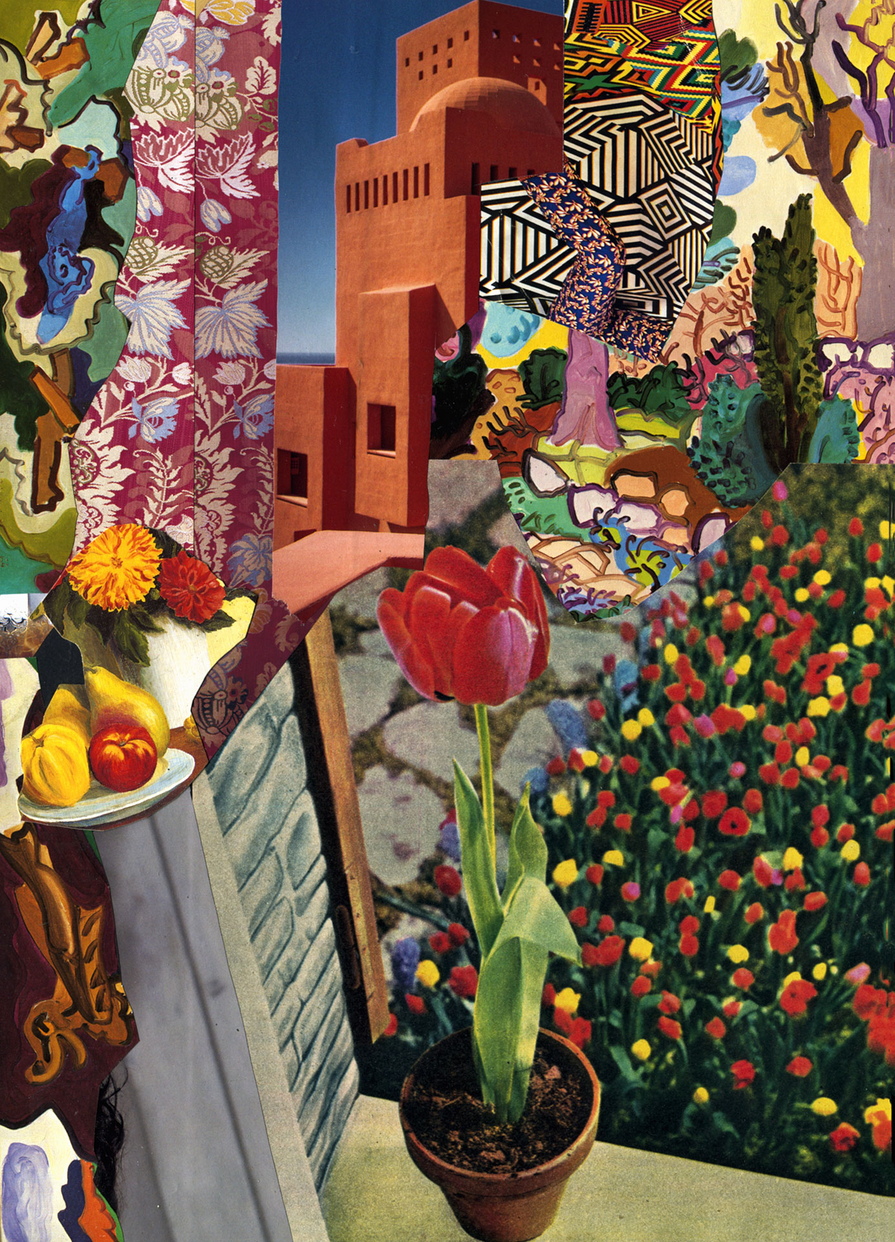
L’ajustement reste ma préoccupation majeure dans le collage. C’est le véritable moteur de l’image par l’effet de surprise qui se crée quand deux morceaux du puzzle s’ajustent parfaitement pour créer un nouvel ensemble. J’ai parlé de greffes, de sutures, mais ces mots me parlent moins aujourd’hui. Le mot qui me vient à l’esprit aujourd’hui est « fluidité ». Les bouts d’images s’assemblent pour former un tout harmonieux et les traces de l’assemblage que sont perçues point comme des obstacles. Évidemment, les images tendent donc vers une harmonisation à dominante sombre (Caravaggio, Rembrandt, Goya) ou claire (Watteau, les Impressionnistes), mais je n’ai pas l’impression d’y perdre en expressivité. Dans mes paysages, je pense à la manière dont R. Walser décrit ses pérégrinations (Reisebericht), où tout est en mouvement grâce à sa pensée attentive à tout. Dans un récent collage, j’ai fait le bilan de mes années « jardin » en évoquant le jardin Majorelle de Marrakech qui m’avait littéralement ouvert les yeux sur la splendeur des couleurs. J’avais, de manière répétée, essayé d’évoquer ce souvenir en mélangeant peinture et collage. Mais c’est cette fois-ci que j’ai le sentiment d’avoir pu « coller » à mon souvenir et mes sensations d’alors. En revoyant mes tentatives des années 1999-2000, j’ai pu constater combien je n’avais pas réussi à faire régner la fluidité partout dans le tableau et que, de ce fait, celui-ci tombait littéralement en pièces. Une autre préoccupation, beaucoup plus facile à réaliser, c’est la variété des sujets de mes collages. Bien sûr, certains sujets sont récurrents, mais je me permets des excursions du côté des surréalistes, expressionnistes, cubistes, baroqueux etc. selon la photo qui est mon point de départ. Alors que je recherche avant tout des doubles pages, je m’amuse ces temps à faire des doubles pages à partir de deux pages différentes, mais qui peuvent s’harmoniser quand même car ne faut-il point toujours rechercher de nouveaux défis au lieu de se borner d’encaisser la rente de ses anciennes trouvailles ?
You must be logged in to see the comments. Log in now!
Form is loading...
18.06.19
Enfer et paradis
Tout se mélange : le teddy de mon enfance avec mon clown en fer blanc qui tambourine sur le quai de la gare de Bâle, la découverte de la Suisse. Mon ours en peluche faisait du bruit quand on lui pressait le ventre et ne m’a pas quitté jusqu’à ce que je grandisse et lui ouvre le ventre pour voir d’où venait le bruit. Il avait d’ailleurs souffert d’un début d’incendie dans ma chambre tout en haut dans la maison du paysan chez qui on nous avait logés, nous, les enfants. Le clown m’a accompagné de ma ville natale jusqu’en Suisse. J’avais 6 ans. Devant passer tout seul la douane, je me suis retrouvé sur le quai parmi les voyageurs dont les bagages étaient fouillés sur place. Un douanier ouvre ma valise et en sort ce clown tambourineur qui se tient sur le quai, minuscule, un peu ridicule et perdu dans la foule, comme moi. Heureusement qu’on m’attend à la sortie ! Et à partir de là, c’est le pays de cocagne que je découvre. C’est l’été, il fait beau, la propriété descend jusqu’au lac Léman, l’eau chaude coule des robinets, il y a du bon lait, du chocolat, des visages amicaux. Après 6 mois d’enfer en Bavière et la maltraitance subie par les diaconesses hollandaises, voici le paradis ! Du coup, mes parents ne me manquent pas et surtout pas ma ville natale avec ses ruines, les tuberculeux qui crachent le sang, les coupures de courant et l’horrible école grise avec ses enfants persécuteurs. Maudite ville si cruelle avec sa minorité non aryenne, se réjouissant de son malheur et se dépêchant d’oublier ses crimes une fois le désastre consommé. Quelle joie de te quitter, d’y retourner le moins possible, d’aller vivre dans le pays merveilleux qui a illuminé mon enfance !


Vous devez être connecté pour voir les commentaires. Se connecter maintenant!
Formulaire en cours de chargement...
12.04.18
Upside down
Sens dessus dessous
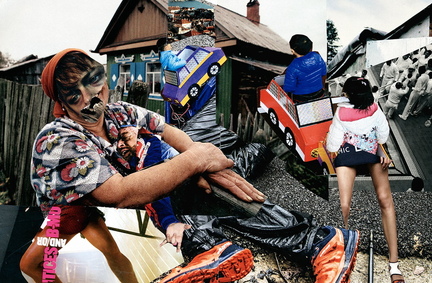
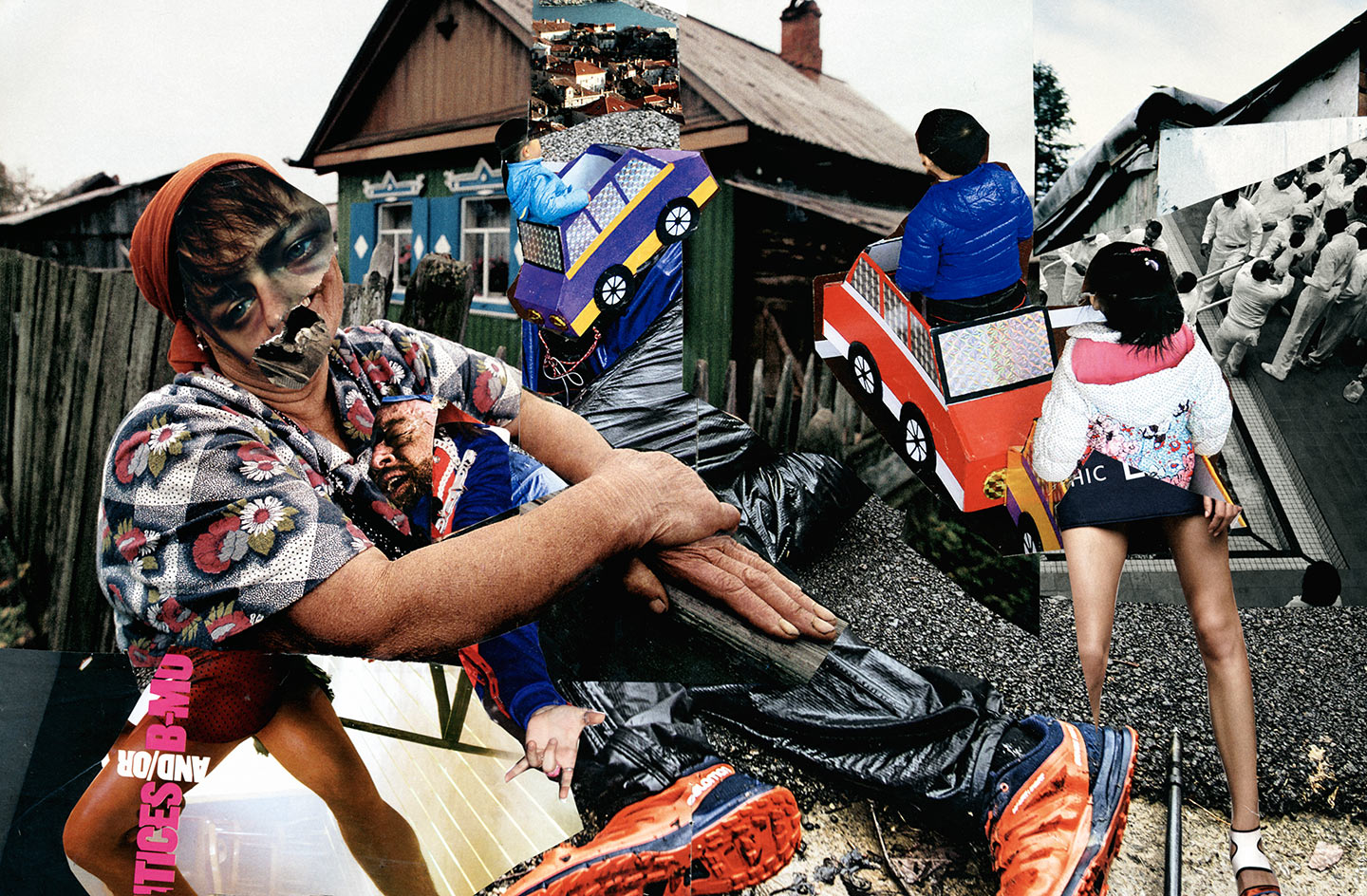
Dans cette image, je remonte à l’époque de mon enfance qui se mélange avec les images suscitées par mes récentes lectures (Kaputt de Malaparte) : un véritable chaos. Cela se passe à l’Est de l’Europe, sur des terres qui ont vu les pires horreurs et dont ont ne sort pas indemne, même après 70 ans. Mais j’ai tenté de mélanger l’humour avec le tragique comme chez Mihuleac dans America de peste pogrom, tout en respectant mes propres sentiments d’horreur et en repensant – encore – aux souffrances de ma grand-mère, battue à mort à Riga et à ma tante qui a réussi à revenir de Theresienstadt , malade et moralement brisée. J’avais lu Kaputt quand j’étais encore adolescent et je me rends compte, après tant d’années, que je n’avais pas compris l’importance de ce livre. Je n’avais pas suffisamment vécu pour en appréhender la portée. A quoi bon se retourner sur le passé ? En ce jour de célébration du souvenir de la Shoah à Genève, il fallait bien que j’y participe à ma manière. Bien sûr que ce collage ne me vaudra pas beaucoup de « like » sur Fb, mais je dois être fidèle à mon art, sans me préoccuper de ce qu’on peut en penser en un clic, en simples termes de j’aime – j’aime pas.
Upside down
In this image, I go back to the time of my childhood which mixes with the images evoked by my recent readings (Malaparte’s Kaputt): a real chaos. This is happening in Eastern Europe, on lands that have seen the worst horrors and have not come out unscathed, even after 70 years. But I tried to mix humor with tragedy like Mihuleac in America de peste pogrom, while respecting my own feelings of horror and rethinking - still - the sufferings of my grandmother, beaten to death in Riga and to my aunt who managed to come back from Theresienstadt, sick and morally broken. I had read Kaputt when I was still a teenager and I realize, after so many years, that I did not understand the importance of this book. I had not lived enough to understand the scope. What is the point of turning back to the past? On this day of celebration of the Holocaust remembrance in Geneva, I had to participate in my own way. Of course, this collage will not be worth a lot of "like" on Fb, but I must be true to my art, without worrying about what you can think of it in a click, in simple terms of I like - do not like.
You must be logged in to see the comments. Log in now!
Form is loading...
16.03.18
The cavern - La grotte
C’est une vue d’une caverne éventrée. Il y a beaucoup de monde. Un personnage tient, par le fil, une ampoule allumée qui éclaire la main d’un géant – Polyphème ? Il a deux yeux pourtant. Est-ce que la lumière n’éclaire pas plutôt les personnages en train de dégringoler dans la neige ? J’ai l’impression d’avoir fait une image à l’instar de mes préoccupations du moment, à tenter de jeter de la lumière sur l’histoire de ma famille maternelle. Je n’en connais que des bribes, mes parents n’aimaient guère évoquer le temps du nazisme et des persécutions, les fuites et les déportations. Et moi, je n’étais pas assez curieux pour demander, questionner. J’essaie donc d’y voir un peu plus clair aujourd’hui. Avec internet, je peux glaner des bribes d’informations, même si c’est bien peu.
A regarder mon image maintenant, j’y vois un peu ce qui est arrivé à cette famille : fuyant une catastrophe (la Russie tsariste des pogromes) et arrivant dans un pays qui va les prendre au piège : l’Allemagne, à l’instar des personnages qui s’écroulent au premier plan.
Comment préserver la lumière ? Comment vivre dans les ruines d’une civilisation ? Je me retrouve, pour finir, dans le personnage géant qui, comme Jérémie, se lamente sur les ruines de Jérusalem.
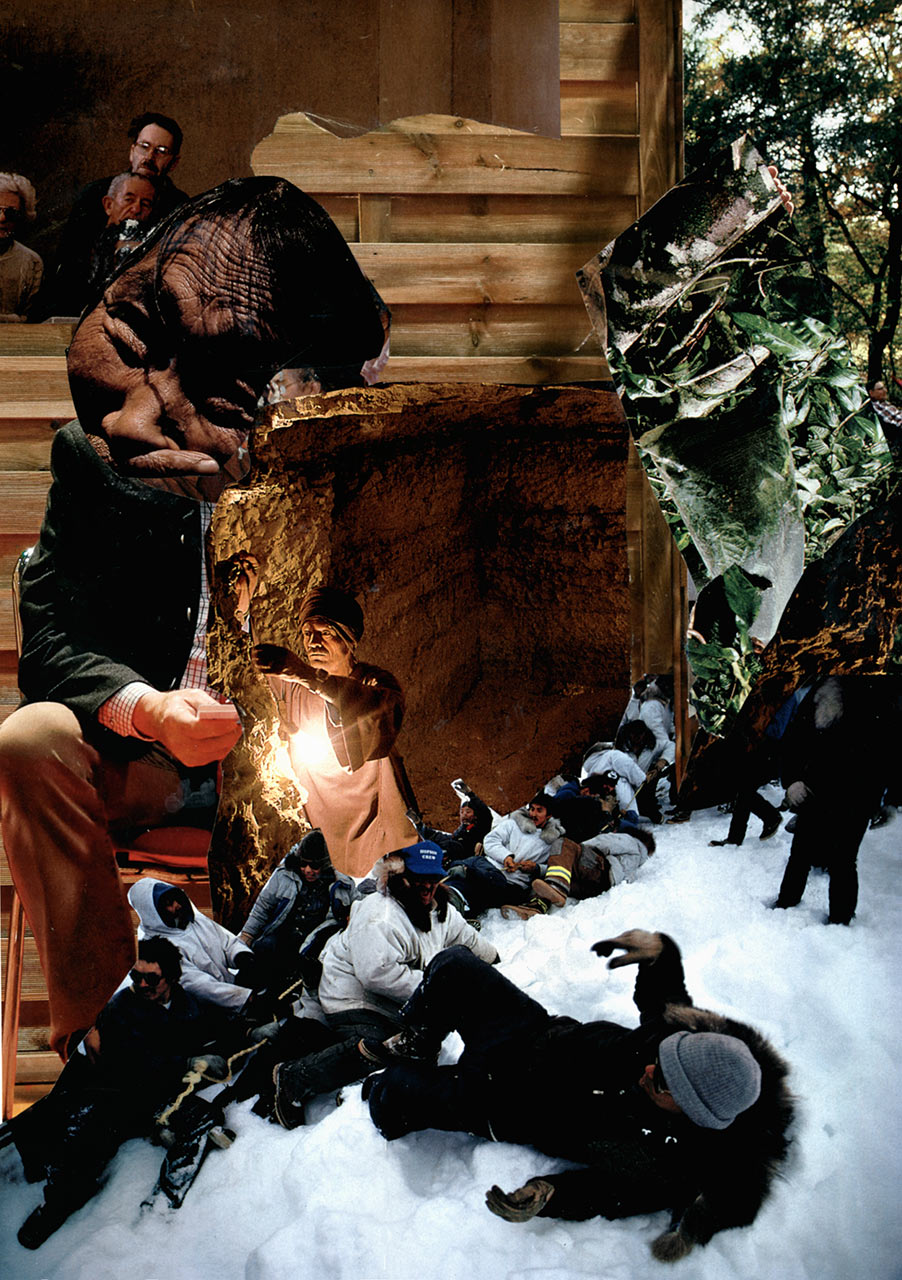
It is a view of a ripped open cavern. There are a lot of people. A character holds, by the wire, a lighted bulb which illuminates the hand of a giant - Polyphemus? He has two eyes though. Does not the light shine on characters tumbling in the snow? I feel I have made an image about my current concerns, trying to shed light on the story of my maternal family. I only know bits and pieces, my parents did not like to talk about Nazism and persecution, flight and deportation. And I was not curious enough to ask, to question. So, I'm trying to get a little clearer today. With the internet, I can glean bits of information, even if it is very little.
Looking at my image now, I see a little what happened to this family: fleeing a catastrophe (Tsarist Russia pogroms) and arriving in a country that will trap them: Germany, like the characters crumbling in the foreground.
How to preserve the light? How to live in the ruins of a civilization? Finally, I find myself in the giant figure who, like Jeremiah, laments the ruins of Jerusalem.
You must be logged in to see the comments. Log in now!
Form is loading...
01.03.18
The lion hunt - La chasse au lion
J’ai vu récemment un reportage sur Rubens et j’ai été ébloui par ses peintures, notamment sa chasse au lion. En feuilletant un magazine chez mon cardiologue, je suis tombé sur des photos d’Afrique que j’ai immédiatement voulu transformer. Muni de ce magazine, je me suis mis à faire mon propre tableau de chasse, sans penser à Rubens. Ce n’est qu’une fois sorti de mon état de transe et contemplant mon image en buvant une bière que j’ai vu que les Rubens avaient fait leur chemin en moi. Bien sûr que je ne saurais me mesurer à ce génie : c’est son énergie qui se retrouve dans mon collage. Ne cherchez pas de correspondances avec le Rubens, c’est l’esprit du peintre, sa « furia » qui résonne dans mon image. Par ailleurs, j’ai voulu faire un clin d’œil à la domestication des félins et à l’abondance de photos de mignons petits chats sur les réseaux. La réalité est bien plus crue, la chair reste la chair et la mort cruelle comme ici.

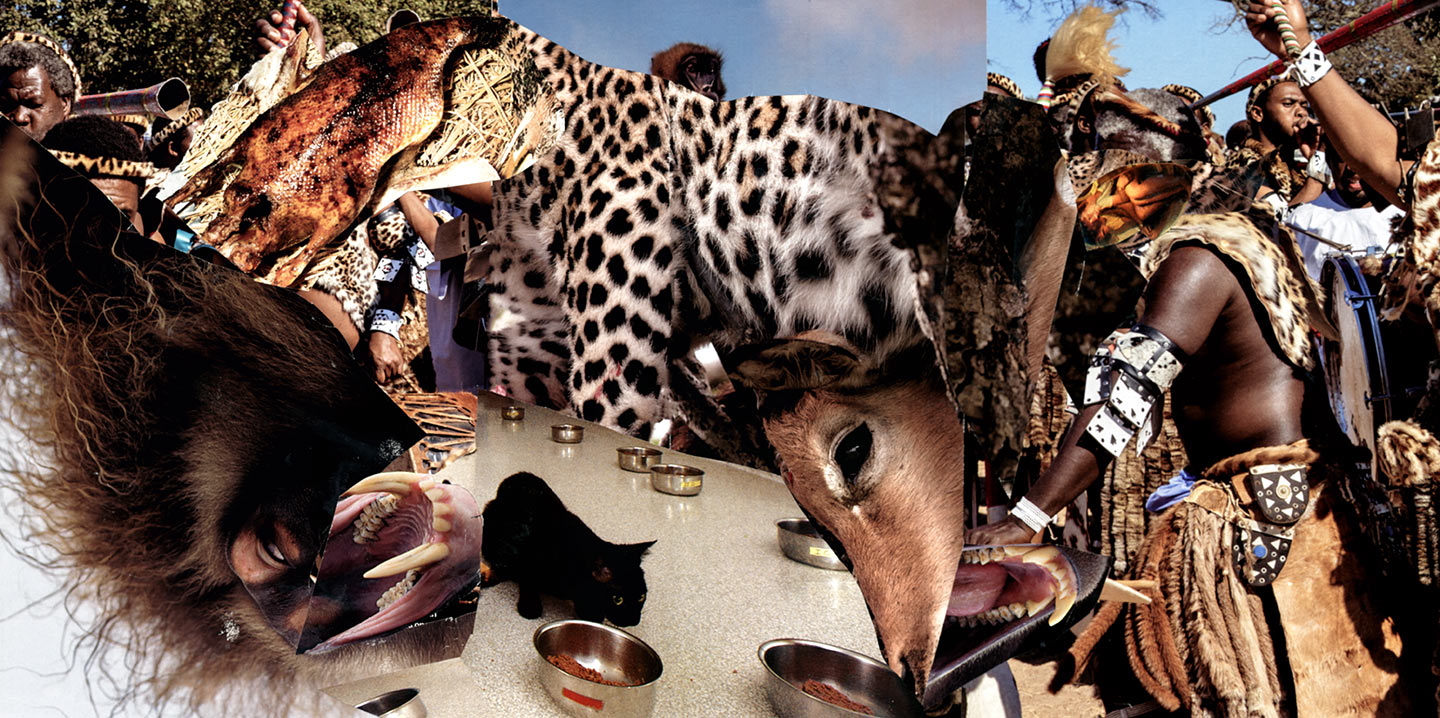
I recently saw a broadcast on Rubens and I was dazzled by his paintings, including his lion hunt. While leafing through a magazine at my cardiologist, I came across photos of Africa that I immediately wanted to transform. Equipped with this magazine, I started to make my own hunting table, without thinking of Rubens. It was only when I left my trance state and contemplated my image while drinking a beer that I saw that the Rubens had made their way inside me. Of course I cannot measure myself against this genius: it is his energy that found its way into my collage. Do not look for correspondences with the Rubens, it's the spirit of the painter, his "furia" that resonates in my image. In addition, I wanted to make a nod to the domestication of cats and the abundance of pictures of cute little kitties on the networks. The reality is much more crude, flesh remains t flesh and death cruel as here.
You must be logged in to see the comments. Log in now!
Form is loading...
20.02.18
Beach
Ce collage est le fruit d’une longue lutte pour obtenir une image cohérente. Je suis parti de trois femmes assises dont on voit encore des fragments dans l’image finale. Ayant commencé la veille, j’ai bouleversé la composition le lendemain en insérant les poissons et les gens prenant le soleil sur les rochers. Ces deux motifs me semblent indiquer, à la fois formellement et au niveau de l’impression, qu’il s’agit d’objets jetés là par les vagues, comme on peut le voir sur certaines plages polluées. Le plan supérieur gauche montre une nature plus intacte, mais dévorée par le monstre à tête de poisson qui est une réminiscence des créatures infernales de J. Bosch. Les gens au soleil sont comme des moutons, ils ont les yeux fermés ignorant ce qui se passe de l’autre côté. Et la figure centrale pousse un cri muet, elle est comme ces poissons morts qui ont la gueule ouverte.
Ce n’est évidemment pas un collage très léger, pourtant j’éprouve une grande satisfaction à le contempler. Peut-être parce que j’ai l’impression d’avoir réuni ici la tradition picturale classique et une vision moderne, désenchantée, du monde. Heureusement que les parties hautes apportent de la sérénité et un espoir de pérennité, sinon on se trouverait réellement en enfer.
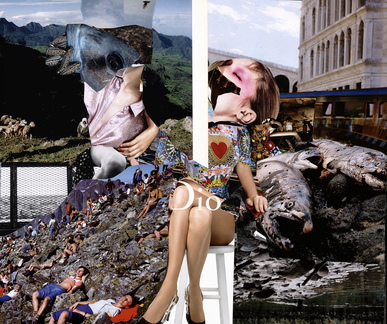
This collage is the result of a long struggle to obtain a coherent image. It started with three seated women whose fragments are still visible in the final image. Having begun the day before, I upset the composition the next day by inserting the fish and the sunbathers on the rocks. These two motives seem to indicate, in my view, both formally and at the level of the impression, that they are objects thrown there by the waves, as one can see it on certain polluted beaches. The upper left plan shows a more intact nature but devoured by the fish-head monster that is reminiscent of H. Bosch's infernal creatures. The people on the rocks are like sheep, their eyes are closed, they do not know what's happening on the other side. And the central figure utters a mute cry, she's like those dead open-mouthed fishes.
It is obviously not a very light collage; however, I feel a great satisfaction to contemplate it. Perhaps because I have the impression of having gathered here the classic pictorial tradition and a modern, disenchanted vision of the world. Fortunately, the high parts bring serenity and hope for sustainability, otherwise we would really be in hell.
There is one comment on this post but you must be logged in to see the comments. Log in now!
Form is loading...
26.01.18
The problem with Berni
My parents wanted to call me Berni, but this name was not accepted by the authorities. I was then imposed that other name: Bernd which appeared on my papers. But nobody in my entourage called me otherwise than Berni, except the teachers who preferred the other name. It was more Germanic (the final d is pronounced t), harder. They thought and they wrote it once: a berni was just a child, it was just a diminutive and you had to grow, harden, isn’it? And also, write with the right hand, the left hand is not intended for such use. So, I hated and still hate the name Bernd and I got rid of it during my Swiss naturalization. Failing to finally call me Berni as I would have liked, I was offered Bernard as a consolation. Go with Bernard, but it's not me, of course. Later, my friend had the same reflex as my teachers saying that Berni was childish and that I needed another name, Stéphane. Why not, but it still could not be me. Besides, at the Beaux-Arts, I was called Stephanus instead of Berni. After the break with C., I quickly recovered my first name, but alas, the German practice in 1941 to put the names of the godfathers in front of the usual name played me a trick: during the computerization of data, the Swiss authorities decided that I was officially called Werner from now on. Here is the situation: all my friends know me under Berni, my Swiss driving license, my family book etc. under Bernard, because established long before the digital revolution, and all the recent documents under Werner. In fact, I do not care, I know who I am and I'm happy to call me Berni, period. Thinking back to this administrative mess, I remembered that in my maternal Schwarzmann family, my grandfather was originally called Mordko, but after his naturalization, he became Max; my uncle had to go from Lev to Leo, only the girls could keep their original name. I'm just perpetuating the maternal family tradition that shows a certain adaptability, unlike the paternal family who knew only two male first names: Herrmann and Richard. I was nearly on it !
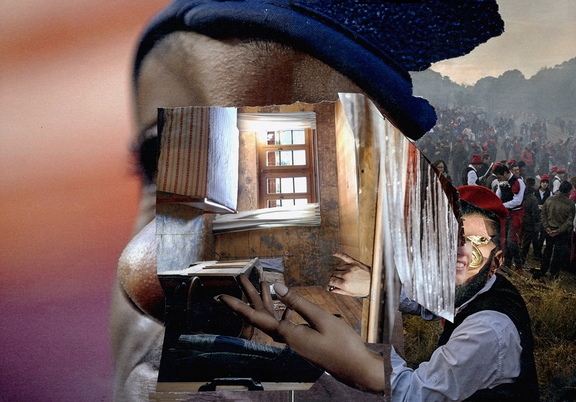
Mes parents voulaient m’appeler Berni, mais ce prénom n’a pas été accepté par les autorités. On m’a alors imposé cet autre prénom : Bernd qui figura sur mes papiers. Or personne dans mon entourage ne m’appelait autrement que Berni, mais les professeurs préféraient l’autre prénom. Il faisait plus germanique (le d final se prononce t), plus dur. Ils pensaient et ils l’ont écrit une fois qu’un berni n’était qu’un enfant, ce n’était qu’un diminutif et il fallait grandir, se durcir, n’est-ce pas ? Et aussi, écrire de la main droite, la main gauche n’étant pas destinée à un tel usage. Du coup, j’ai détesté et déteste encore le prénom Bernd et je m’en suis débarrassé lors de ma naturalisation suisse. A défaut de pouvoir enfin m’appeler Berni comme je l’aurais souhaité, on m’a proposé Bernard en guise de consolation. Va pour Bernard, mais ce n’est pas moi, évidemment. Plus tard, mon amie a eu le même réflexe que mes profs en disant que Berni faisait enfantin et qu’il me fallait un autre prénom, Stéphane. Pourquoi pas, mais ça ne pouvait toujours pas être moi. D’ailleurs, aux Beaux-Arts, on m’appelait bien Stephanus au lieu de Berni. Après la rupture avec C., j’ai vite fait de récupérer enfin mon prénom à moi, mais hélas, la pratique allemande en 1941 de mettre les noms des parrains devant le prénom usuel m’a joué un tour pendable : au cours de l’informatisation des données, les autorités helvétiques ont décidé que je m’appelais dorénavant officiellement Werner. Voici la situation : tous mes intimes me connaissent sous Berni, mon permis de conduire suisse, mon livret de famille etc. sous Bernard, car établi longtemps avant la révolution numérique, et tous les documents récents sous Werner. En fait, je m’en fiche, je sais qui je suis et je suis content de m’appeler Berni, point barre. En repensant à cet imbroglio administratif, je me suis souvenu que dans ma famille maternelle Schwarzmann, mon grand-père s’appelait initialement Mordko, mais après sa naturalisation, il est devenu Max ; mon oncle, lui, a dû passer de Lev à Léo, seules les filles ont pu garder leur prénom. Je ne fais que perpétuer la tradition familiale maternelle qui fait montre d’une faculté d’adaptation certaine, contrairement à la famille paternelle qui ne connaissait que deux prénoms mâles : Herrmann et Richard. Je l’ai échappé belle !
You must be logged in to see the comments. Log in now!
Form is loading...

You must be logged in to see the comments. Log in now!